
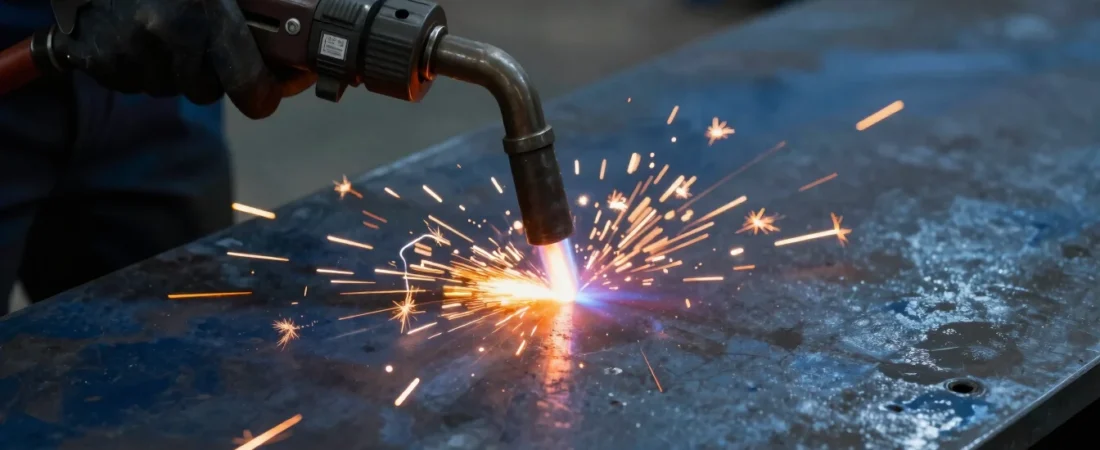
An oxy-fuel cutting torch is still one of the most versatile tools in a fabrication shop, a scrapyard or on a construction site. It needs no electricity, it cuts thick carbon steel that would stop most plasma systems, and the same outfit can often weld, braze and heat as well. But torches that look alike can differ a lot in the details that matter to your customers: tip compatibility, fuel gas, cutting capacity, duty rating and build quality.
This guide walks through those details from a buyer’s point of view, whether you run a welding supply store, distribute torches to resellers, or equip your own workshop.
How oxy-fuel cutting works (and what it can’t cut)
A cutting torch first heats the steel with a preheat flame of oxygen and fuel gas until the surface reaches its ignition temperature, roughly 870–900 °C (about 1,600 °F), where the steel glows bright cherry red. Pressing the cutting oxygen lever then releases a jet of pure oxygen that rapidly oxidizes the hot iron and blows the molten oxide out of the cut.
Because the process relies on burning iron, it works well on carbon steel and low-alloy steel. It is not suitable for stainless steel or aluminum, which form oxides with very high melting points, or for copper alloys, which conduct heat away too quickly. Those materials are usually cut with plasma or mechanical methods instead.
1. Combination torch or dedicated cutting torch?
There are two common formats:
- Combination torch: a welding torch handle with a screw-on cutting attachment. The same handle accepts welding tips, heating nozzles and the cutting attachment, which makes it popular with general workshops, maintenance crews and occasional users.
- Straight (dedicated) cutting torch: a one-piece torch built only for cutting, such as the 62-3F type. It is usually more rigid, often available in longer lengths, and preferred for heavy daily cutting in fabrication, shipbreaking and scrap processing.
If your customers cut occasionally and also weld or braze, stock combination outfits. If they cut all day, a dedicated cutting torch is the better buy.
2. Choose the style your market already uses
Torch styles, usually named after the original design they are compatible with, matter more than most buyers expect, because tips are the repeat purchase. A customer who already owns American-style torches will keep buying tips that fit them. Common styles include:
- Victor-type (American style) torches, widely used in North America
- Harris 62-3F type heavy-duty straight cutting torches
- Brazil-type and French-type hand cutting torches
- Japanese, British, Russian and other regional styles
Tips from different styles are generally not interchangeable, because each style uses its own tip seat and thread. Before choosing a supplier, list the styles and tip series your customers already use, and make sure the torch and its tips are offered together. For a closer look at the two most common American styles, see our comparison of Victor-type and Harris-type cutting torches.
3. Pick the fuel gas: acetylene or propane?
Most cutting torches can run on more than one fuel gas, but each fuel needs matching tips and a suitable regulator. The two most common choices are acetylene and propane:
| Acetylene | Propane | |
|---|---|---|
| Flame temperature with oxygen | About 3,100 °C (5,600 °F), the hottest common fuel | About 2,800 °C (5,100 °F) |
| Oxygen use (approx. ratio to fuel) | About 1–1.5 : 1 | About 4–4.5 : 1 |
| Preheat speed | Fastest; good for quick starts and thin plate | Slower to start; strong heat on thick plate |
| Welding steel | Yes, the standard fuel for oxy-fuel welding | No; fine for heating and brazing |
| Typical tips | Acetylene cutting tips | Two-piece propane / natural gas tips |
| Cost and handling | Higher gas cost; special handling rules | Lower gas cost; widely available |
Acetylene is the right choice when customers also weld or need fast preheat. Propane and natural gas are popular for cutting thicker plate at a lower gas cost, especially in high-volume shops. Whatever the fuel, remember the basic acetylene safety rule: never use acetylene at a working pressure above 15 psig (about 1 bar).
4. Cutting capacity depends on the tip
Torch specifications often quote a maximum cutting thickness, such as “up to 300 mm”. In practice, the torch body sets the upper limit, but the tip size and oxygen supply decide what a given setup can cut. Small tips give a narrow kerf and clean cuts on thin plate; large tips and higher oxygen flow are needed for thick sections.
When comparing torches, ask the supplier for the tip chart: tip sizes, recommended oxygen and fuel pressures, and the steel thickness range for each tip. Distributors should also check that the full tip range is available, not just the most common sizes.
5. Duty rating, length and head angle
- Duty rating: light-duty torches suit maintenance and occasional work; medium-duty torches cover most workshop cutting; heavy-duty torches are built for continuous cutting of thick plate.
- Length: standard hand torches are roughly 450–550 mm long. Longer torches, for example 650 mm or 1,100 mm, keep the operator further from heat, sparks and molten metal in scrap and demolition work.
- Head angle: 75° and 90° heads are the most common for hand cutting; 180° (straight) heads are used for special applications. Match the angle your customers are used to.
6. Check the build quality
Two torches with the same style and specification can feel very different after six months of use. Points worth checking on samples:
- Brass head and body: machining finish, clean threads and a smooth, accurate tip seat
- Gas tubes: stainless steel tubes are stiffer and resist bending better than plain brass tubes
- Valves: needle valves should adjust smoothly and shut off fully without excessive force
- Cutting oxygen lever: firm action, no wobble, and no oxygen leaking at rest
- Grip and balance: comfortable for long cuts, with no sharp edges
7. Safety features and factory testing
Oxy-fuel equipment works with high-pressure oxygen and flammable gas, so testing matters more than appearance. Ask your supplier which tests are done and whether they apply to every unit or only to samples. At a minimum, look for:
- Gas-tightness (leak) test on every torch, valve and connection
- Flashback test to confirm the torch handles backfire safely
- Visual inspection of finish, threads and markings before packing
On the user side, check valves and flashback arrestors at the regulator or torch add an important layer of protection, and many markets expect them. If you sell into a regulated market, confirm which standards apply. For reference, ISO 5172 covers torches (blowpipes) and ISO 5175 covers safety devices such as flashback arrestors.
8. Connections and regulators
Hose connections must match the regulators and hoses your customers use. In North America, most torches use 9/16″-18 “B-size” fittings, with a right-hand thread for oxygen (green hose) and a left-hand thread for fuel gas (red hose, marked with a groove on the nut). Other markets use different standards, so confirm the connection type before ordering. Pair the torch with suitable oxygen and fuel gas regulators, and consider complete torch kits for first-time buyers.
Buyer’s checklist before you order
- Torch format (combination or straight) and style (Victor-type, Harris-type or regional styles)
- Fuel gas and the matching tip series
- Tip chart: sizes, pressures and cutting range
- Duty rating, length and head angle
- Connection standard for your market
- Factory tests performed on every unit, and test records
- Samples for hands-on evaluation
- MOQ, lead time, payment terms and packaging, including private label
FAQ
Can one cutting torch use both acetylene and propane?
Many torches can, but each fuel needs its own tips, and the regulator and hose fittings must suit the gas. Always use tips designed for the fuel you are running.
What thickness can an oxy-fuel torch cut?
Hand torches typically cut carbon steel from a few millimetres up to roughly 100–300 mm, depending on the torch, tip size and oxygen supply. Check the tip chart for the exact range.
Why don’t tips fit torches of another style?
Each style uses its own tip seat, thread and gas passage design, so tips are matched to a torch family. Mixing them can cause leaks or unsafe operation.
Sourcing cutting torches for your business
FHtorch manufactures oxy-fuel cutting torches in Ningbo, China, in Victor-type, Harris 62-3F type, Brazil-type and French-type styles, along with tips, regulators and complete kits. Every torch is leak-tested and flashback-tested before shipping, and we offer OEM logo marking and private-label packaging. Samples are free (you pay courier shipping), the MOQ is 100–300 units per model and the lead time is about one month. Request a quote, or read our guide to sourcing welding and cutting tools from China.
Victor® and Harris® are trademarks of their respective owners. FHtorch is not affiliated with them; style names are used only to describe compatibility.