
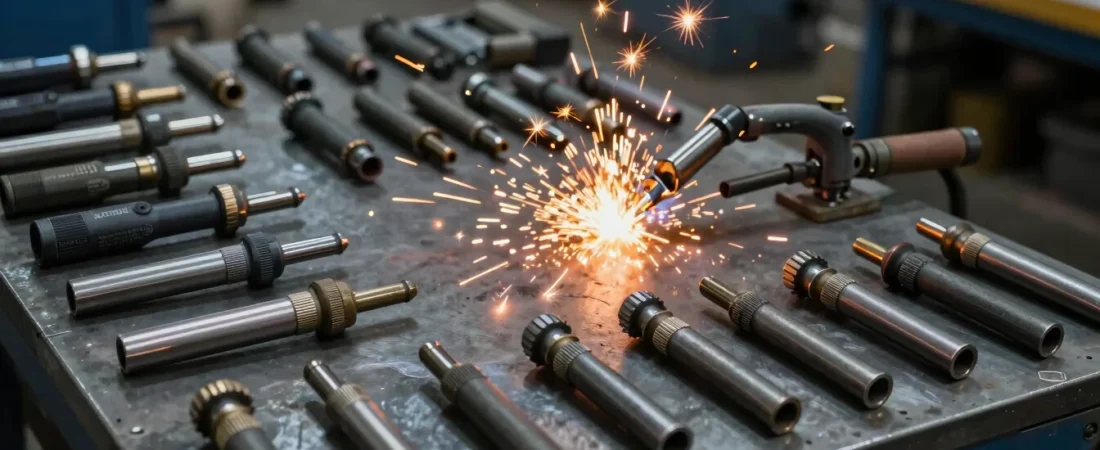
If you sell oxy-fuel equipment in North America, or to buyers who use American-style gear, two torch families come up again and again: Victor-type torches and Harris-type torches, especially the heavy-duty 62-3F style. Both are proven designs, both are made by many manufacturers in compatible “type” versions, and both have loyal users. This guide explains the practical differences so you can decide what to stock.
Victor® and Harris® are trademarks of their respective owners. “Victor-type” and “Harris-type” describe compatible designs; FHtorch is not affiliated with either brand.
Why “type” torches exist
Professional users rarely change torch families. Their tips, spare parts and habits are built around one style, so when a torch wears out they look for a replacement that accepts the same tips and feels the same in the hand. Type torches meet that demand: they follow the established design so they work with the tips and accessories the user already has, usually at a more competitive price. For a distributor, choosing the right style is less about the torch itself and more about the tips your customers will keep buying.
Victor-type vs Harris 62-3F type at a glance
| Victor-type (American style) | Harris 62-3F type | |
|---|---|---|
| Design family | Broad American-style range: welding handles, cutting attachments and straight cutting torches | Heavy-duty straight cutting torch |
| Typical tips | Victor-type tips, e.g. 1-101 series for acetylene and two-piece GPN-style tips for propane | 6290-series type tips |
| Typical use | General fabrication, maintenance, combination outfits and kits | Heavy daily cutting, thick plate, scrap and demolition |
| Typical cutting range* | 5–300 mm, depending on tip | Up to 200 mm with acetylene, 150 mm with propane |
| Lengths* | Standard hand-torch length | 480 mm, 650 mm and 1,100 mm |
| Hose connections (North America) | 9/16″-18 B-size fittings | 9/16″-18 B-size fittings |
*Typical values for FHtorch’s versions of each style. Actual capacity depends on the tip, gas and oxygen supply. Outside North America, confirm the connection standard for your market.
Difference 1: Tips and tip seats
This is the difference that matters most. Victor-type and Harris-type torches use different tip seats, threads and gas passage designs, so their tips are not interchangeable. A shop with ten Victor-type torches will keep ordering Victor-type tips; a shop running Harris 62-3F type torches needs 6290-series type tips.
For a distributor this means two things. First, check your customers’ installed base before choosing a style: the tip business usually outlasts the torch sale. Second, if you add a new style, add its full tip range too, including the less common sizes for thick plate.
Difference 2: Construction and duty
The Victor-type family covers a wide range, from light combination outfits (a welding handle plus a cutting attachment) to medium and heavy-duty straight cutting torches. That flexibility makes it a common choice for general workshops and for kits sold to first-time buyers.
The Harris 62-3F type is a dedicated heavy-duty straight cutting torch. FHtorch’s version uses triangular stainless steel gas tubes for rigidity, two stainless steel needle valves and a head-mixing design, and it comes in long lengths that keep operators further from heat and slag. It suits users who cut thick plate every day.
Difference 3: Cutting capacity and fuel gas
Both styles cut a wide range of carbon steel thicknesses, and both can run on acetylene or propane with the right tips. In both cases, capacity is set mainly by the tip size and the oxygen supply rather than by the torch body alone. When you compare offers from suppliers, ask for the tip chart for each style and compare like for like: same tip size, same gas, same plate thickness.
Difference 4: Feel and user habits
Operators notice the grip, the lever position, the valve placement and the balance of a torch. Experienced users tend to stay with the style they learned on, which is another reason to follow your market rather than push a new style. Samples are the quickest way to check whether a type torch feels right to your customers.
Which style should you stock?
- Stock Victor-type if your customers are general workshops, maintenance teams and kit buyers in North America, or if they already use Victor-type tips.
- Stock Harris 62-3F type if your customers do heavy daily cutting, need long torches for scrap and demolition, or already run 6290-series type tips.
- Stock both if you serve a mixed customer base. Keep the tips clearly organized by style so counter staff do not mix them up.
In markets outside North America, also consider regional styles such as Brazil-type and French-type torches. Our cutting torch buyer’s guide covers the other factors to check, from fuel gas to duty rating.
Quality checks for type torches
A compatible torch is only as good as the factory that makes it. Before placing an order, ask for samples and check the tip fit with your existing tips, the smoothness of the valves and lever, and the machining of the head. Ask whether every torch is leak-tested and flashback-tested, and request the test records with your quote.
FAQ
Are Victor and Harris tips interchangeable?
No. The two families use different tip seats and threads. Always use tips made for the torch style.
Can both styles use propane?
Yes, with propane tips designed for that style and suitable regulators. Acetylene tips should not be used with propane.
Which style is better for heavy cutting?
Both families include heavy-duty options, but the Harris 62-3F type is a dedicated heavy-duty straight torch and a common choice for continuous thick-plate cutting.
Get samples of both styles
FHtorch manufactures Victor-type cutting torches and Harris 62-3F type cutting torches in Ningbo, China, with OEM logo marking and private-label packaging. Samples are free (you pay courier shipping), the MOQ is 100–300 units per model and the lead time is about one month. Request a quote and tell us which tips your customers use.