


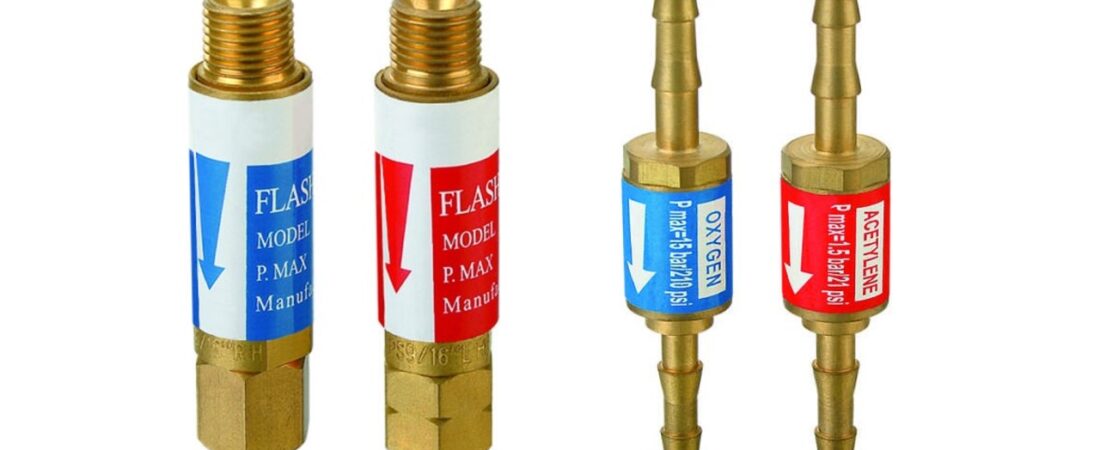
Customers who buy oxy-fuel equipment often ask the same question: do I need flashback arrestors, check valves or both, and where do they go? The two devices look alike and are often sold side by side, but they do different jobs. This guide explains the difference in plain terms, shows where each one is fitted and lists what to check before you add them to your range.
This is general information for distributors. Users should always follow the equipment manufacturer’s instructions and local safety rules. Victor® is a trademark of its owner; “Victor-type” describes the style and fit of our products, and FHtorch is not affiliated with it.
Backfire, flashback and reverse flow
Three terms come up again and again:
- Backfire: the flame burns back into the tip with a sharp pop and goes out or relights. Typical causes are touching the work with the tip, an overheated tip or wrong gas pressures.
- Flashback: the flame burns back through the torch into the hoses and, in the worst case, towards the regulator and cylinder. A flashback can destroy equipment and start a fire.
- Reverse flow: one gas flows back into the other gas’s hose, for example oxygen pushing into the fuel gas hose when pressures are unbalanced or the tip is blocked. This creates an explosive mixture inside the hose, which is how many flashbacks start.
Check valves and flashback arrestors are designed to deal with the last two.
What a check valve does
A check valve, also called a non-return valve, is a one-way valve. It lets gas flow towards the torch and closes when gas tries to flow back, so it stops reverse flow before a dangerous mixture can build up in a hose.
What a check valve cannot do is stop a flame. If a flashback happens, the flame passes straight through it. Check valves are small and inexpensive and are usually fitted at the torch inlets. Our 88-3 compact check valves fit directly on the torch.
What a flashback arrestor does
A flashback arrestor combines two protections: a flame-arresting element that stops a flame front from travelling further upstream, and a non-return valve that blocks reverse flow. Our arrestors also have a filter that keeps dirt away from the element. Some designs on the market add a temperature- or pressure-sensitive cut-off valve as well.
In short: a check valve stops gas flowing the wrong way; a flashback arrestor stops reverse flow and a flame.
Where each device is fitted
| Position | Device | FHtorch models |
|---|---|---|
| Regulator outlet | Flashback arrestor | 288 (9/16″×18), B288 (BSP 3/8″), 588 (9/16″×18) |
| Hose line | Inline cartridge arrestor | 388 and 488, for Φ8 mm hose |
| Torch inlet | Flashback arrestor or check valve | H188 arrestors, 588, 88-3 check valves |
| Inside the torch | Built-in arrestors and check valves | Victor-type cutting torches MH001-008 and MH001-005 |
A widely used setup is a flashback arrestor on each regulator outlet, one for oxygen and one for fuel gas, plus check valves or arrestors at the torch inlets. Requirements differ from country to country, so check the rules in your market.
Torches with built-in flashback arrestors and check valves, such as our Victor-type MH001-008, need no separate devices at the torch end. For many customers they are an easy safety upgrade.
Oxygen and fuel gas versions
Every device comes in an oxygen version and a fuel gas version, and the two are not interchangeable. Oxygen fittings use right-hand threads and fuel gas fittings use left-hand threads, usually shown as R and L in the model number: our H188-R is for oxygen and H188-L for fuel gas.
Threads also vary by market. Our H188 torch arrestors, for example, are made with 9/16″×18, 5/8″×18, BSP 3/8″ and BSP 1/4″ connections. Stock the threads that match the regulators and torches your customers use.
Flow and pressure ratings
Every arrestor adds some resistance to gas flow. If it is too small for the job, the torch can be starved of gas, especially with large cutting tips or multi-flame heating nozzles. Compare each device’s maximum flow with your customers’ largest tips and nozzles.
Our arrestors are rated up to 7,000 L/h for oxygen and 2,600 L/h for fuel gas, with a maximum inlet pressure of 10 bar for oxygen and 1.5 bar for acetylene.
Inspection and replacement
- Check devices regularly for damage, dirt and correct one-way operation, as the maker’s instructions describe.
- After a flashback, take the device out of service and replace it or have it checked.
- Replace any device that leaks or is damaged.
- Keep oil and grease away from oxygen fittings.
What to check before you stock them
- Gas and thread options: oxygen and fuel gas versions in the threads your market uses.
- Flow and pressure ratings that suit your customers’ tips and heating nozzles.
- A filter that protects the flame-arresting element.
- Testing: ask how each batch is tested and, if your market requires certification, which standard the devices are tested to, for example ISO 5175-1 for flashback arrestors and ISO 5175-2 for check valves.
- Clear marking and packaging: gas type, flow direction and model on every device, plus retail packaging if you sell to shops.
FAQ
Is a check valve enough on its own?
A check valve stops reverse gas flow, but it cannot stop a flame. To protect against flashback, use flashback arrestors, most commonly at the regulator outlets.
Do both the oxygen and fuel gas lines need protection?
Most safety guides recommend protecting both lines, which is why arrestors and check valves are made in oxygen (right-hand) and fuel gas (left-hand) versions.
Does a torch with built-in arrestors need extra devices?
Not at the torch end. Whether to fit arrestors at the regulators as well depends on local rules and customer practice.
Can a flashback arrestor be reused after a flashback?
Follow the manufacturer’s instructions. As a rule, take the device out of service after a flashback and replace it or have it checked.
Source flashback arrestors from FHtorch
We make torch-mounted H188, regulator-mounted 288 and B288 and cartridge 388, 488 and 588 flashback arrestors, plus 88-3 check valves, all in oxygen and fuel gas versions, as well as Victor-type cutting torches with arrestors and check valves built in. The MOQ is 100–300 units per model, the lead time is about one month, and samples are free (you pay the courier). Browse our flashback arrestors or request a quote with your models, threads and quantities.