


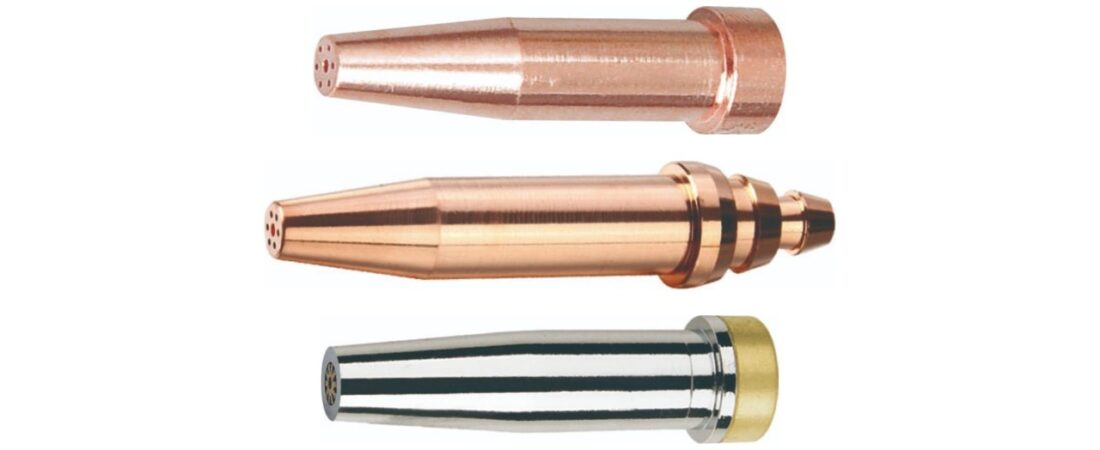
A cutting torch is sold once, but its tips are bought again and again. Every torch your customers use creates steady demand for replacement tips, so the tips you stock shape your repeat sales, and how often customers come back with the wrong part. This guide explains how tip series, fuel gases and sizes fit together, so you can build a tip range that matches the torches already in your market.
Victor® and Harris® are trademarks of their respective owners. “Victor-type” and “Harris-type” describe compatible designs; FHtorch is not affiliated with these companies.
Why the tip matters more than it looks
The torch mixes and delivers the gases, but the tip decides what the flame does. Its preheat holes shape the preheat flame, and its central orifice forms the cutting oxygen stream. That is why the tip, not the torch, sets the cutting thickness, the gas consumption and much of the cut quality.
Tips also wear out. Spatter, heat, knocks and repeated cleaning slowly damage the orifice and the face, so busy shops replace tips regularly. And because every torch style uses its own tip seat and thread, a customer who buys the wrong series simply cannot use it.
Step 1: Match the tip series to the torch style
Start with the torches your customers already own. Each torch style has its own tip series, and tips from different styles are not interchangeable. This table shows the main series we make and the equipment they fit.
| Torch style | Acetylene tips | Propane / LPG tips | Sizes |
|---|---|---|---|
| Victor-type torches and cutting attachments | 1-101 | GPN (also natural gas) | 000–8 |
| Harris-type torches and attachments, including our 72-3 cutting attachment | 6290 series | 6290NXM | 000–6 |
| British-style hand cutting torches, such as our NM-250 and G02-200 | ANM and ANME | PNME9 and PNME18 | 1/64″–1/8″ |
| Equipment using type “A” nozzles | – | Type “A” (LPG) | 1–3 |
If a customer is unsure which style they have, ask for the brand and model, or a photo of the torch head and tip. When you add a new style to your range, test sample tips in the torches your customers actually use before you order in volume.
Step 2: Match the tip to the fuel gas
Acetylene and propane or LPG burn very differently. Acetylene gives a hot, concentrated preheat flame and is also used for gas welding. Propane and LPG are usually cheaper and easy to buy, but they need a different preheat design. That is why each torch style has separate tip series for each gas: on Victor-type torches, for example, 1-101 tips are for acetylene and GPN tips are for propane and natural gas. Our cutting torch buyer’s guide compares the two gases in more detail.
Many propane and LPG tips use a two-piece design, such as our type “A” nozzles with a brass body and copper tip, and our two-tone GPN tips. Whatever the design, the rule for your customers is simple: always use tips made for the gas in the cylinder. A shop that switches from acetylene to propane needs a new set of tips.
Step 3: Read the tip sizes
On Victor-type and Harris-type tips, the size is a number: the higher the number, the larger the cutting orifice and the thicker the steel it cuts. Our 1-101 and GPN tips run from size 000 to 8, and our Harris-type 6290 series from 000 to 6. British-style nozzles use fractional inch sizes from 1/64″ to 1/8″, which describe the cutting orifice: a 1/32″ nozzle has a 0.8 mm orifice, a 1/8″ nozzle a 3.2 mm one.
As a guide, this is how size relates to cutting thickness for our 1-101 acetylene tips:
| Size | Orifice (mm) | Cutting thickness (mm) |
|---|---|---|
| 000 | 0.7 | 1–3 |
| 00 | 0.8 | 3–6 |
| 0 | 1.0 | 6–10 |
| 1 | 1.2 | 10–20 |
| 2 | 1.5 | 20–40 |
| 3 | 1.8 | 40–60 |
| 4 | 2.1 | 60–80 |
| 5 | 2.5 | 80–125 |
| 6 | 3.0 | 125–200 |
| 7 | 3.5 | 200–250 |
| 8 | 4.0 | 250–300 |
Figures differ between series and manufacturers, and the right gas pressures matter as much as the size, so always supply the pressure chart with the tips. You will find the full charts, including oxygen and fuel gas pressures, on each of our tip pages.
Step 4: Build your stocking assortment
- Follow your torch range. For every torch style you sell, carry its tip series in the gases your customers use.
- Stock deeper in the middle sizes. On our 1-101 tips, sizes 0 to 3 cover 6–60 mm steel, the range many fabrication and repair shops cut every day. Keep fewer of the smallest sizes, and stock the largest sizes mainly if you serve scrap yards, demolition or heavy plate work.
- Offer tip sets. A pouch or box with three to five common sizes is an easy add-on when a customer buys a torch or kit. We can pack sets with your choice of sizes in your own branded packaging.
- Label clearly. Print the series, size and gas on every package to cut wrong-part returns.
- Add the small extras. Tip cleaners and similar accessories sell well alongside tips.
Step 5: Check quality before you commit
Two tips can look identical and cut very differently. When you evaluate a supplier, check:
- The orifice: round, centred and free of burrs, so the cutting oxygen stream runs straight.
- The seat: clean, accurate seating surfaces that seal gas-tight in your customers’ torches.
- The material: copper tips, or a brass body with a copper tip for two-piece designs.
- Consistency: how each batch is inspected. Compare several samples, not just one.
Then make test cuts at the pressures on the chart and look at the cut face and the slag. Our tips are made in our Ningbo factory, and samples are free (you pay the courier), so you can test before you order.
FAQ
Can acetylene tips be used with propane?
No. Use tips designed for the fuel gas in use. Acetylene tips do not give a proper propane preheat flame, so switching gases means switching tips.
Are Victor-type and Harris-type tips interchangeable?
No. The two styles use different tip seats and threads. Our guide to Victor vs Harris type cutting torches explains the differences.
How often do cutting tips need replacing?
It depends on how much a tip is used and how it is treated. Replace a tip when cleaning no longer restores a straight, clean cutting stream, or when the seat or face is damaged.
What do the size numbers mean?
Higher numbers have larger orifices for thicker steel. British-style nozzles use fractional inch sizes instead, from 1/64″ to 1/8″.
Source cutting tips from FHtorch
We make Victor-type 1-101 and GPN tips, Harris-type 6290 and 6290NXM tips, British-style ANM, ANME and PNME nozzles and type “A” LPG nozzles in Ningbo, China, alongside the torches and attachments they fit. The MOQ is 100–300 units per model, the lead time is about one month, and we can add your logo and packaging. Browse our cutting tips or request a quote with your models and quantities.